Sub-Total: $0.00 USD

Have questions about this assay kit?
Human AVPR1B Reporter Assay Kit
Product Description and Product Data
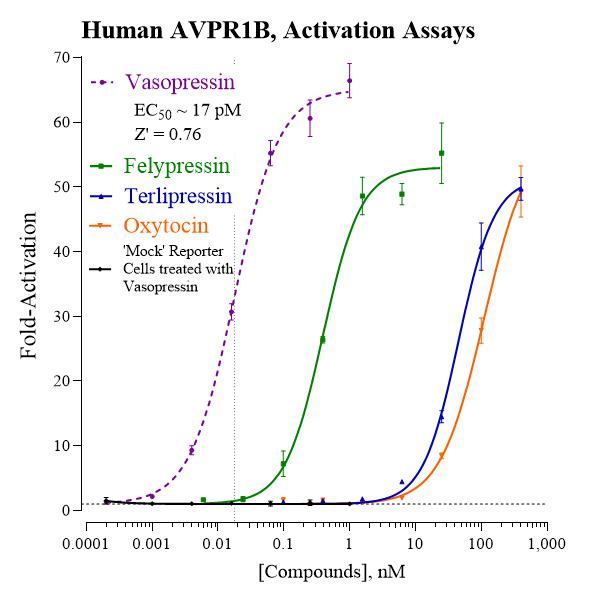
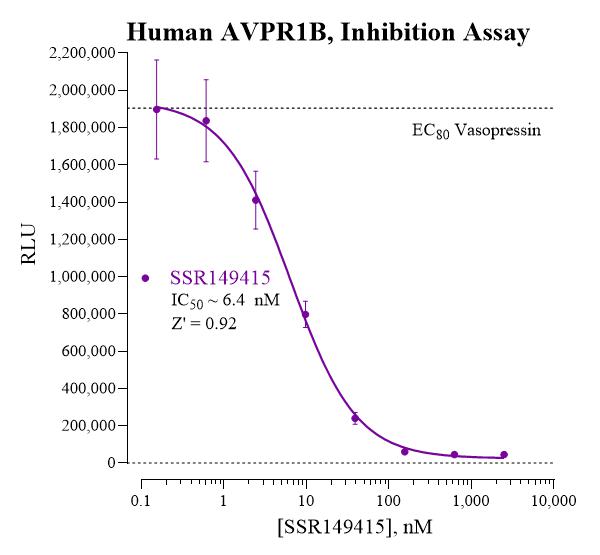
This is an all-inclusive cell-based luciferase reporter assay kit targeting the Human Arginine Vasopressin Receptor 1B (AVPR1B). INDIGO’s AVPR1B reporter assay utilizes proprietary mammalian cells that have been engineered to provide constitutive expression of the AVPR1B. In addition to AVPR1B Reporter Cells, this kit provides two optimized media for use during cell culture and in diluting the user’s test samples, a reference agonist, Luciferase Detection Reagent, and a cell culture-ready assay plate. The principal application of this assay is in the screening of test samples to quantify any functional activity, either agonist or antagonist, that they may exert against AVPR1B. This kit provides researchers with clear, reproducible results, exceptional cell viability post-thaw, and consistent results lot to lot. Kits must be stored at -80C. Do not store in liquid nitrogen. Note: reporter cells cannot be refrozen or maintained in extended culture.
Features
Clear, Reproducible Results
- All-Inclusive Assay Systems
- Exceptional Cell Viability Post-Thaw
- Consistent Results Lot to Lot
Product Specifications
| Target Type | GPCR | ||
| Species | Human | ||
| Receptor Form | Hybrid | ||
| Assay Mode | Agonist, Antagonist | ||
| Kit Components |
| ||
| Shelf Life | 6 months | ||
| Shipping Requirements | Dry Ice | ||
| Storage temperature | -80C |
Data
Target Background
The Arginine Vasopressin Receptor 1B (AVPR1B), also known as vasopressin 3 receptor, is a member of the family of G-Protein-coupled receptors (GPCR). There are three subtypes of vasopressin receptors identified in humans, which are AVPR1A, AVPR1B and AVPR2.
The natural ligand of AVPR1B is vasopressin, which is synthesized in the hypothalamus and secreted into the posterior pituitary. Like the closely similar neuropeptide, oxytocin, vasopressin is a nine amino acid neuropeptide that is classified as an antidiuretic hormone(ADH). Release of vasopressin is mediated by stimuli such as hemorrhage or dehydration. When vasopressin binds to AVPR1B signal transduction is mediated through Gaq/11 GTP binding proteins.
Like their respective ligands, vasopressin receptors and the oxytocin receptor (OXTR) are structurally similar (e.g., 85% between AVPR1A and OXTR)5. However, ligand selectivity for those receptors is different. The affinity of vasopressin for AVPR1A and AVPR1B is similar to that of the OXTR, whereas oxytocin has a significantly higher affinity for OXTR relative to the vasopressin receptors.
Although many peripheral tissues such as kidney, thymus, heart, lung, and spleen express AVPR1B, high expression of AVPR1B was detected in the anterior pituitary. The major role of AVPR1B in the brain is to stimulate production and secretion of adrenocorticotropin (ACTH) and cortisol . It has been suggested that AVPR1B is synergistically involved in the stress-induced activation of stress-reactive hypothalamic-pituitary-adrenal (HPA) axis with corticotropin-releasing hormone receptor-1 (CRHR1).
Due to its earlier discovery, AVPR1A has been studied more intensively than AVPR1B. However, AVPR1B is recognized as an important modulator of the endocrine stress response. Indeed, several knockout mice studies indicate that AVPR1B plays important roles in modulating such behaviors as social recognition memories and normal aggression.

Citations
Also available as a service