Sub-Total: $0.00 USD

Have questions about this assay kit?
Human B2R Reporter Assay Kit
Product Description and Product Data
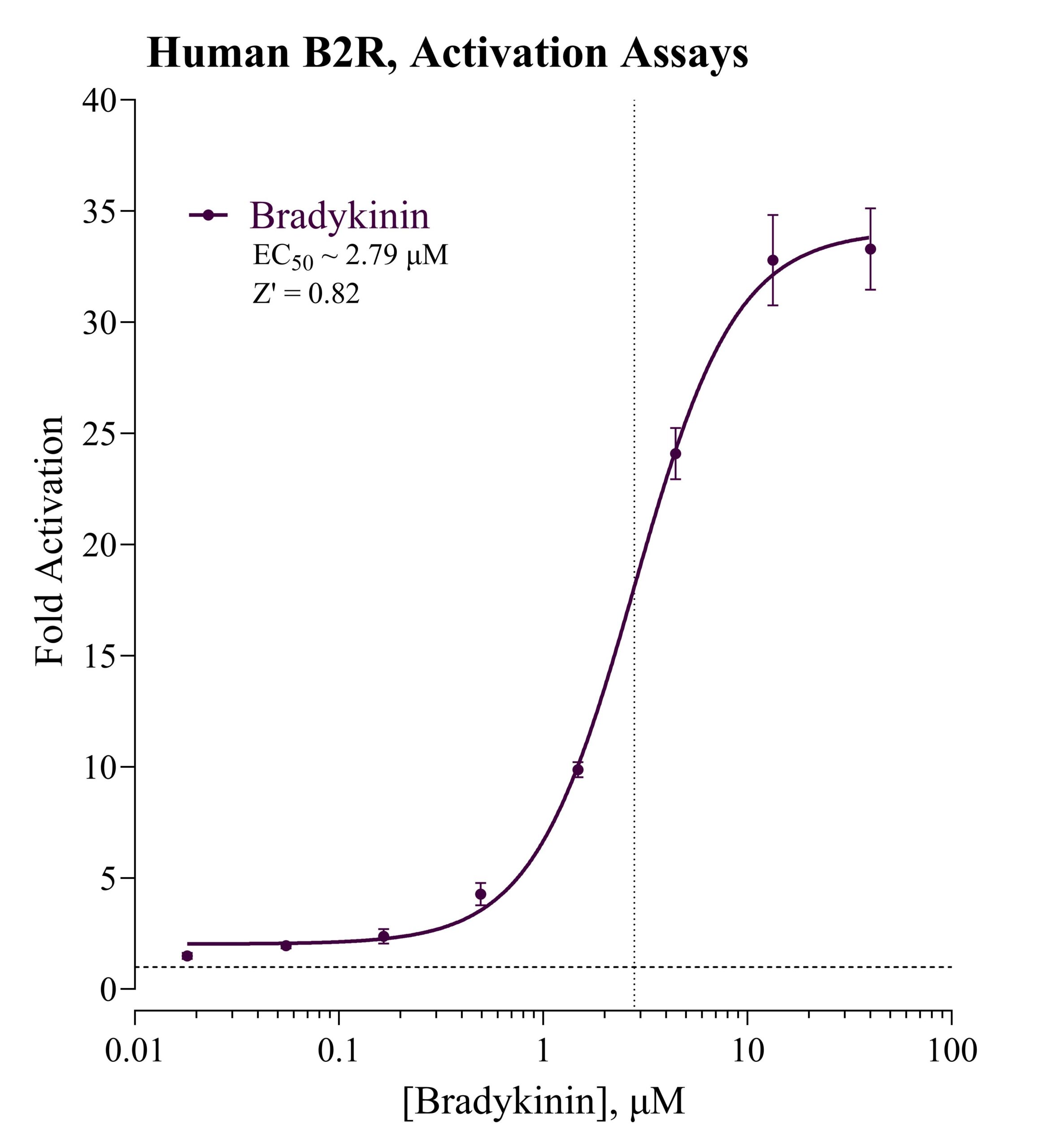
This is an all-inclusive cell-based luciferase reporter assay kit targeting the the Human Bradykinin B2 Receptor Reporter Assay System (B2R). INDIGO’s B2R reporter assay utilizes proprietary mammalian cells that have been engineered to provide constitutive expression of the B2R. In addition to B2R Reporter Cells, this kit provides two optimized media for use during cell culture and in diluting the user’s test samples, a reference agonist, Luciferase Detection Reagent, and a cell culture-ready assay plate. The principal application of this assay is in the screening of test samples to quantify any functional activity, either agonist or antagonist, that they may exert against B2R. This kit provides researchers with clear, reproducible results, exceptional cell viability post-thaw, and consistent results lot to lot. Kits must be stored at -80C. Do not store in liquid nitrogen. Note: reporter cells cannot be refrozen or maintained in extended culture.
Features
Clear, Reproducible Results
- All-Inclusive Assay Systems
- Exceptional Cell Viability Post-Thaw
- Consistent Results Lot to Lot
Product Specifications
| Target Type | GPCR | ||
| Species | Human | ||
| Receptor Form | Hybrid | ||
| Assay Mode | Activation, Inhibition | ||
| Kit Components |
| ||
| Shelf Life | 6 months | ||
| Shipping Requirements | Dry Ice | ||
| Storage temperature | -80C |
Data
Target Background
This assay utilizes proprietary human cells that provide constitutive expression of the receptors that comprise the Bradykinin B2 Receptor (B2R).
Bradykinin receptors are class A G protein-coupled receptors (GPCRs) that respond to kinin peptides. These receptors play an important role in mediating pain, increasing vascular permeability, and vasodilation. The Bradykinin receptor family includes two main subtypes: the Bradykinin B1 Receptor (B1R) which is synthesized de novo following tissue injury, and the constitutively expressed Bradykinin B2 Receptor (B2R).
B2R is ubiquitously expressed and found in most healthy human tissue. It can be activated by the nonapeptide Bradykinin and by the decapeptide Kallidin. Upon activation, B2R primarily signals through the Gq/11 pathway leading to calcium mobilization, triggering the release of vasodilators such as prostaglandins, which play a role in lowering blood pressure. B2R can also form functional dimers with different GPCRs such as angiotensin II type 1 receptor (AT1R). The AT1-B2 heterodimers play a role in hypertensive cardiovascular disorders such as preeclampsia hypertension. Unlike B1R, B2R undergoes rapid desensitization and internalization via β-arrestins following agonist stimulation. Due to the many important roles played by B2R, dysregulation of the receptor can have pathological consequences such as cardiovascular diseases, renal diseases, and hereditary angioedema (HAE).

Citations
Also available as a service