Sub-Total: $0.00 USD

Have questions about this assay kit?
Human GHSR1a Reporter Assay Kit
Product Description and Product Data
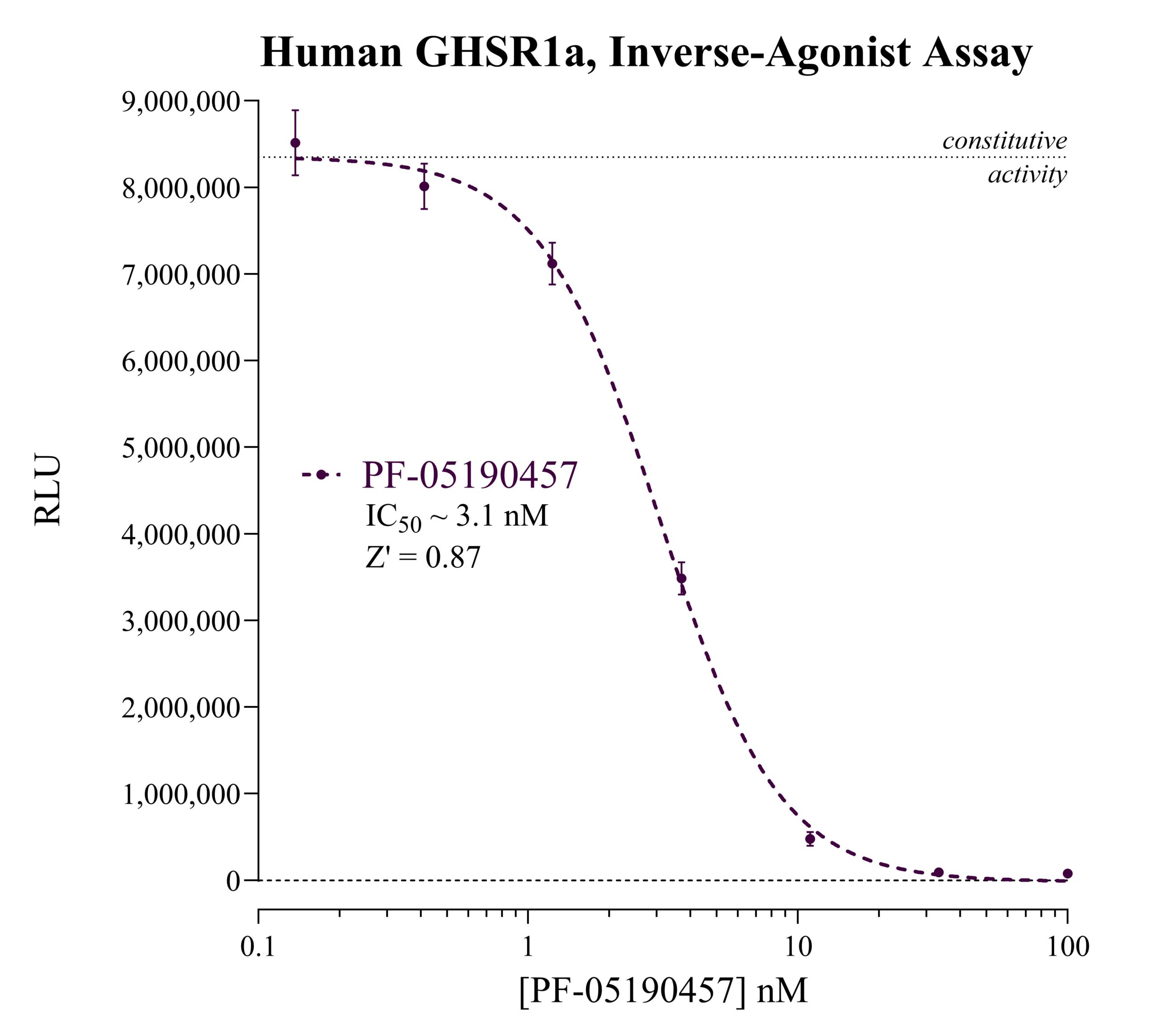
This is an all-inclusive cell-based luciferase reporter assay kit targeting the the Human Growth Hormone Secretagogue Receptor Type 1a (GHSR1a). INDIGO’s GHSR1a reporter assay utilizes proprietary mammalian cells that have been engineered to provide constitutive expression of the GHSR1a. In addition to GHSR1a Reporter Cells, this kit provides two optimized media for use during cell culture and in diluting the user’s test samples, a reference agonist, Luciferase Detection Reagent, and a cell culture-ready assay plate. The principal application of this assay is in the screening of test samples to quantify any functional activity, either agonist or antagonist, that they may exert against GHSR1a. This kit provides researchers with clear, reproducible results, exceptional cell viability post-thaw, and consistent results lot to lot. Kits must be stored at -80C. Do not store in liquid nitrogen. Note: reporter cells cannot be refrozen or maintained in extended culture.
Features
Clear, Reproducible Results
- All-Inclusive Assay Systems
- Exceptional Cell Viability Post-Thaw
- Consistent Results Lot to Lot
Product Specifications
| Target Type | GPCR | ||
| Species | Human | ||
| Receptor Form | Hybrid | ||
| Assay Mode | Inverse Agonist | ||
| Kit Components |
| ||
| Shelf Life | 6 months | ||
| Shipping Requirements | Dry Ice | ||
| Storage temperature | -80C |
Data
Target Background
GHSR1a, also known as Ghrelin Receptor, is a class A G protein-coupled receptor (GPCR) that plays a crucial role in regulating food intake, body weight, glucose homeostasis, and other essential physiological functions.
GHSR1a is activated by ghrelin, a peptide hormone primarily secreted by endocrine cells in the oxyntic mucosa of the stomach. GHSR1a can also adopt constitutively active conformational states, enabling ligand-independent signaling. Its high basal activity makes it particularly responsive to inverse agonists, such as liver-enriched antimicrobial peptide-2 (LEAP2), which serves as both an endogenous competitive antagonist of ghrelin and an inverse agonist that suppresses constitutive GHSR1a signaling. Upon activation, GHSR1a signals through the Gαq/11 pathway, activating phospholipase C (PLC), which leads to an increase in intracellular calcium levels. This is the signaling pathway utilized in this reporter assay.
Modulation of GHSR1a offers a dual therapeutic strategy. Inverse agonists and antagonists are being explored as anti-obesity agents, with the goal of promoting weight loss and improving insulin sensitivity. Conversely, GHSR1a agonists are investigated for their potential to stimulate neurogenesis and improve cognitive function in patients with cognitive decline. This bidirectional approach underscores the significance of GHSR1a as a drug target and has promoted considerable interest in innovative therapies addressing both metabolic and neurological disorders.
Product Documentation

Citations
Also available as a service