Sub-Total: $0.00 USD

Have questions about this assay kit?
Mouse GLP-1R Reporter Assay Kit
Product Description and Product Data
This is an all-inclusive cell-based luciferase reporter assay kit targeting the Mouse Glucagon-Like Peptide-1 Receptor (GLP-1R). INDIGO’s GLP-1R reporter assay utilizes proprietary mammalian cells that have been engineered to provide constitutive expression of the GLP-1R. In addition to GLP-1R Reporter Cells, this kit provides two optimized media for use during cell culture and in diluting the user’s test samples, a reference agonist, Luciferase Detection Reagent, and a cell culture-ready assay plate. The principal application of this assay is in the screening of test samples to quantify any functional activity, either agonist or antagonist, that they may exert against GLP-1R. This kit provides researchers with clear, reproducible results, exceptional cell viability post-thaw, and consistent results lot to lot. Kits must be stored at -80C. Do not store in liquid nitrogen. Note: reporter cells cannot be refrozen or maintained in extended culture.
Features
Clear, Reproducible Results
- All-Inclusive Assay Systems
- Exceptional Cell Viability Post-Thaw
- Consistent Results Lot to Lot
Product Specifications
| Target Type | GPCR | ||
| Species | Mouse | ||
| Receptor Form | Hybrid | ||
| Assay Mode | Agonist, Antagonist | ||
| Kit Components |
| ||
| Shelf Life | 6 months | ||
| Shipping Requirements | Dry Ice | ||
| Storage temperature | -80C |
Data
Target Background
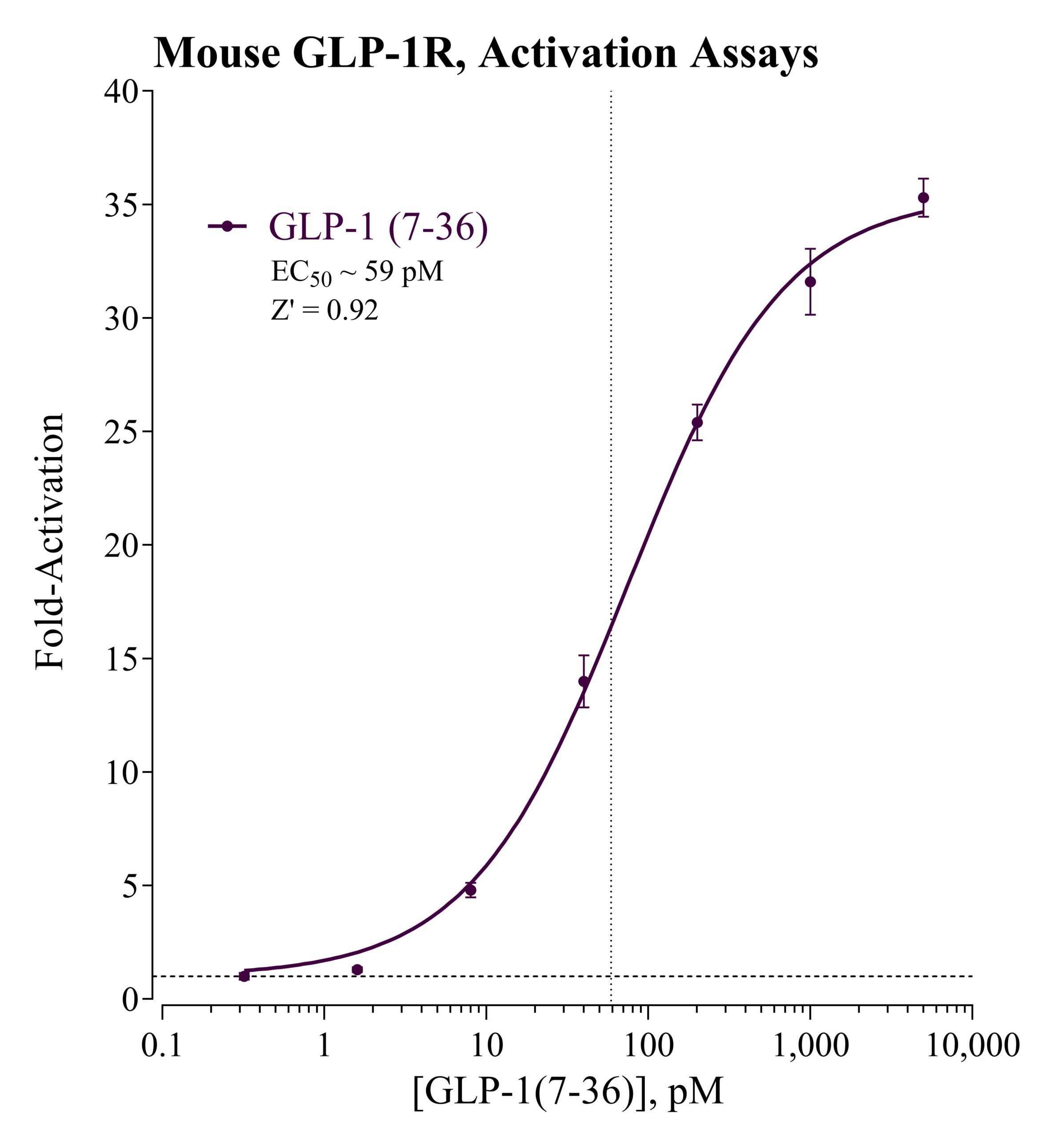
This assay utilizes proprietary cells that provide constitutive expression of the Mouse Glucagon-like Peptide-1 Receptor (mGLP-1R).
The GLP-1R belongs to a class B G protein-coupled Receptor (GPCR), which is activated by several forms of GLP-1. GLP-1 is the second incretin hormone identified in the intestinal epithelial endocrine L-cells, followed by gastric inhibitory polypeptide (GIP). GLP-1/GLP-1R mainly regulates insulin secretion in response to high blood glucose levels. This receptor system plays a crucial role in energy homeostasis.
Upon the ligand binding of GLP-1, GLP-1R signals through Gαs to drive an increase in intracellular cAMP via activation of adenylate cyclase (AC). This signaling pathway continues through the activation of protein kinase A (PKA) and exchange protein activated cAMP (EPAC) dependent mechanisms. Ultimately, the signal transduction cascade stimulates the opening of calcium and cation channels to induce calcium influx, which promotes insulin secretion. cAMP response binding element (CREB) is also activated by GLP-1R to induce the expression of insulin transcription factor in cAMP/PKA-dependent manner.
Because of the significant role of GLP-1/GLP-1R as a key regulator of metabolism, several clinical trials have been attempted to develop therapies for patients with Type II diabetes. For example, GLP-1R agonists (GLP-1RAs) have been introduced as a novel class of therapeutic agent to manage glycemic control.
INDIGO’s Reporter Cells contains an engineered luciferase reporter gene functionally linked to tandem Cyclic AMP Response Elements (CRE) and a minimal promoter. Activated adenylate cyclase results in the production of cAMP, which binds the transcription factor CREB (cAMP Response Element-Binding Protein). Activated CREB binds to CRE sequences, seeding the formation of a complete transcription complex that drives luciferase gene expression. Quantifying relative changes in luciferase enzyme activity in the treated reporter cells relative to the untreated reporter cells provides a sensitive surrogate measure of drug-induced changes in mGLP-1R activity. Accordingly, the principal application of this reporter assay is in the screening of test compounds to quantify any functional activities, either activating or inhibitory, that they may exert against mGLP-1R.

Citations
Also available as a service