Sub-Total: $0.00 USD

Transrepression Assay Services
INDIGO Biosciences provides transrepression assay services to help drug discovery teams evaluate how compounds modulate transcription factor signaling through pathway cross-talk and selective modulation. These studies enable direct measurement of transrepression mechanisms, supporting a more complete understanding of compound activity in endocrine or inflammatory signaling systems.


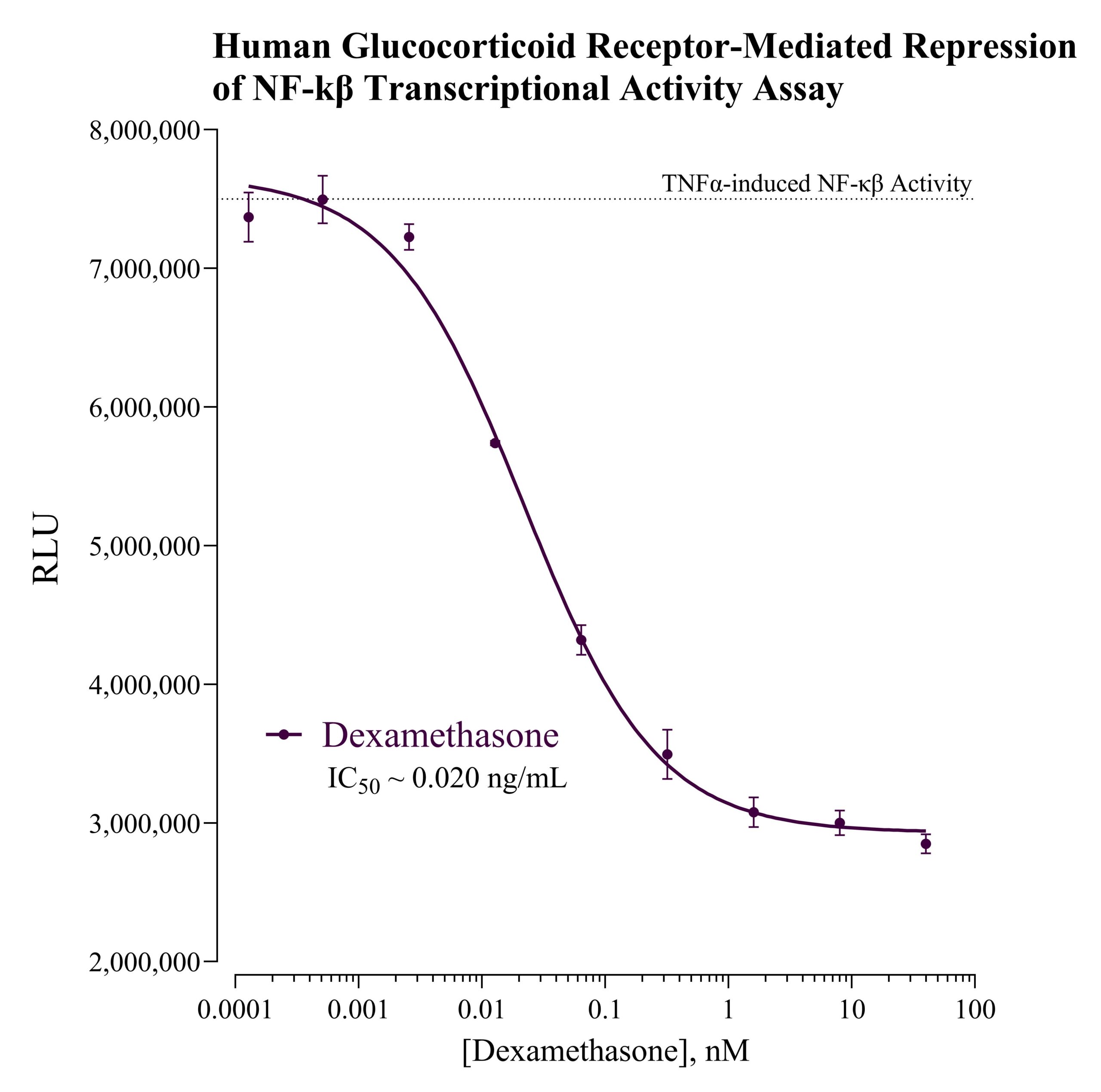
GR/NF-κB Transrepression in
INDIGO's Cell-Based Reporter Assays
Transrepression is a mechanism in which one transcription factor suppresses the activity of another without directly binding DNA at the regulated promoter. This can occur through protein-protein interactions, competition for co-regulators, or recruitment of co-repressors, resulting in reduced transcriptional activity.
A well-characterized example is glucocorticoid receptor (GR)-mediated suppression of NF-κB signaling. In this context, activated GR suppresses NF-κB-driven transcription, providing a functional readout of pathway cross-talk relevant to anti-inflammatory compound characterization and to the evaluation of Selective Glucocorticoid Receptor Modulators (SGRMs).
INDIGO Biosciences currently offers GR/NF-κB transrepression studies in cell-based reporter assay systems, enabling customers to evaluate this specific interaction in a controlled in vitro format and to support programs focused on selective glucocorticoid receptor modulator activity.
For programs involving other transcription factor pathways, INDIGO’s scientists can discuss whether a customized reporter assay approach may be suitable for evaluating additional forms of transcription factor cross-talk or pathway-selective suppression.
INDIGO’s Transrepression Assay Platform
INDIGO’s transrepression assays are based on our luciferase reporter system that measure changes in transcription factor–driven signaling following pathway induction.
INDIGO's defined experimental conditions may include:
- A transcription factor pathway is activated using a controlled stimulus
- Compounds are applied to evaluate modulation of signaling
- Changes in reporter signal are measured as a functional readout of transrepression
This approach enables sensitive, quantitative detection of transcription factor cross-talk in a high-throughput in vitro format.
Our transrepression assays provide a valuable extension to standard reporter assay approaches, offering deeper insight into transcription factor cross-talk and pathway-selective compound activity.
Why Choose INDIGO’s Transrepression Assay Services?
Physiologically Relevant Cell-Based Reporter Assay Systems
INDIGO’s transrepression assays utilize cell-based reporter systems designed to measure transcription factor activity under controlled induction conditions. These systems support evaluation of signaling interactions in a biologically relevant cellular environment.
Quantitative and Reproducible Data
Our platform supports:
- Potency, efficacy, and dose-response analysis
- Direct comparison of compound series
- Mechanistic interpretation of transcription factor-mediated suppression
These outputs provide clear, quantitative insight into transcription factor–mediated suppression.
Actionable Data for Mechanistic Insight
Transrepression assays enable:
- Identification of pathway-selective compound activity
- Differentiation of compounds with similar activation profiles
- Integration with nuclear receptor and pathway reporter assay data
This supports informed decision-making during hit-to-lead and lead optimization stages.
Scientific Support from INDIGO’s Team
INDIGO’s scientists work directly with your team to:
- Align assay conditions with your signaling pathways of interest
- Support study design and execution
- Provide guidance on data interpretation and follow-up studies
INDIGO’s transrepression assay services can support programs focused on:
- Selective glucocorticoid receptor modulator characterization
- Anti-inflammatory compound profiling
- Functional selectivity assessment across related reporter assay formats
- Hit-to-lead and lead optimization studies
- Mechanistic follow-up after nuclear receptor or pathway reporter screening
- Custom evaluation of transcription factor cross-talk and pathway-selective suppression

Get Reliable Transrepression Study Data & Clear Reports from Our Expert Scientists

Full Study Reports
Full study reports with dose-response curves and potency/efficacy values

Reliable Data
Raw and analyzed data for internal review and downstream analysis

Post Study Support
Optional consultation to interpret results and guide next steps
Get your Transrepression Studies Started in Three Simple Steps
Design your next transrepression study rapidly and confidently with our expert team.

Step 1: Request a Quote in One Click
Fill out a Request a Quote form and tell us more about your study goals, compounds, pathways of interest, and desired readouts.

Step 2: Design Your Service Study with Our Scientists
Receive your quote and a custom draft of your Service Work Order.
Review and adjust to fit your needs.

Step 3: Send Your Samples and Get Your Results
Provide your samples or compounds, and we will do the rest.
Receive a complete data package and clear study reports in record time!