Sub-Total: $0.00 USD


Have questions about this assay kit?
Human ADRB3 Reporter Assay Kit
Product Description and Product Data
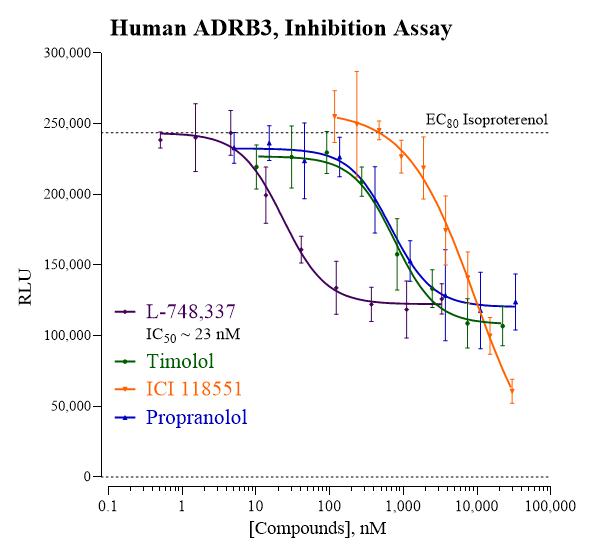
This is an all-inclusive cell-based luciferase reporter assay kit targeting the the Human Adrenoreceptor Beta 3 (ADRB3). INDIGO’s ADRB1 reporter assay utilizes proprietary mammalian cells that have been engineered to provide constitutive expression of the ADRB3. In addition to ADRB1 Reporter Cells, this kit provides two optimized media for use during cell culture and in diluting the user’s test samples, a reference agonist, Luciferase Detection Reagent, and a cell culture-ready assay plate. The principal application of this assay is in the screening of test samples to quantify any functional activity, either agonist or antagonist, that they may exert against ADRB3. This kit provides researchers with clear, reproducible results, exceptional cell viability post-thaw, and consistent results lot to lot. Kits must be stored at -80C. Do not store in liquid nitrogen. Note: reporter cells cannot be refrozen or maintained in extended culture.
Features
Ready to Use Upon Receipt
- Includes All Needed Components
- Contains Transfected Reporter Cells
- Eliminates Cell Licensing Fees
- Clear, Reproducible Results
- Consistent Results Lot to Lot
Product Specifications
| Target Type | GPCR | ||
| Species | Human | ||
| Receptor Form | Hybrid | ||
| Assay Mode | Agonist, Antagonist | ||
| Kit Components |
| ||
| Shelf Life | 6 months | ||
| Shipping Requirements | Dry Ice | ||
| Storage temperature | -80C |
Data
Target Background
The adrenoceptors (a.k.a. adrenergic receptors) mediate the action of the sympathetic nervous system and are activated in response to “fight-or-flight” signals. They are divided into three types, adrenoceptor α1-, α2-, and β. Each type is further composed of three subtypes resulting in 9 different types (α1A, α1B, α1D, α2A, α2B, α2C, β1, β2, and β3). Adrenoceptors belong to the G-Protein-coupled receptor (GPCR) family. They all display the characteristic seven transmembrane helices, the extracellular loops which contribute to ligand binding, and the intracellular carboxy tail that associates with trimeric G proteins. All nine types of adrenoceptors are activated by the same endogenous catecholamines (epinephrine and norepinephrine); however, the specificity of their responses depends on the G-proteins and effector systems they associate with in a tissue and time specific manner.
Adrenoceptor Beta 3 (ADRB3) was the last discovered member of the b-adrenoceptor sub-family and is the least studied. However, its utility as a therapeutic target has been validated by the approval of the ADRB3 agonists Mirabegron and Vibegron, which are used to treat overactive bladder syndrome. An additional feature that makes it a potential target for chronic conditions is that it lacks sites for phosphorylation by protein kinase A and b-adrenoceptor kinase, which are present on the b1 and b2-adrenoceptors, making it potentially resistant to desensitization. ADRB3 is of additional interest as a target for the treatment of metabolic disorders, due to its role in lipolysis and thermogenesis and its expression in white and beige human adipocytes. Further, targeting ADRB3 may be useful for the treatment of cancer, since it has been demonstrated that ADRB3 is over-expressed in the tumor microenvironment, and has also been implicated in other processes including angiogenesis and cancer progression. Its involvement and expression in a variety of physiological processes and cell types, respectively, makes it a promising target in the treatment of multiple diseases.

Citations
Also available as a service