Sub-Total: $0.00 USD


Have questions about this assay kit?
Human GCGR Reporter Assay Kit
Product Description and Product Data
This is an all-inclusive cell-based luciferase reporter assay kit targeting the the Human Glucagon Receptor (GCGR). INDIGO’s GCGR reporter assay utilizes proprietary mammalian cells that have been engineered to provide constitutive expression of the GCGR. In addition to GCGR Reporter Cells, this kit provides two optimized media for use during cell culture and in diluting the user’s test samples, a reference agonist, Luciferase Detection Reagent, and a cell culture-ready assay plate. The principal application of this assay is in the screening of test samples to quantify any functional activity, either agonist or antagonist, that they may exert against GCGR. This kit provides researchers with clear, reproducible results, exceptional cell viability post-thaw, and consistent results lot to lot. Kits must be stored at -80C. Do not store in liquid nitrogen. Note: reporter cells cannot be refrozen or maintained in extended culture.
Features
Clear, Reproducible Results
- All-Inclusive Assay Systems
- Exceptional Cell Viability Post-Thaw
- Consistent Results Lot to Lot
Product Specifications
| Target Type | GPCR | ||
| Species | Human | ||
| Receptor Form | Hybrid | ||
| Assay Mode | Agonist, Antagonist | ||
| Kit Components |
| ||
| Shelf Life | 6 months | ||
| Shipping Requirements | Dry Ice | ||
| Storage temperature | -80C |
Data
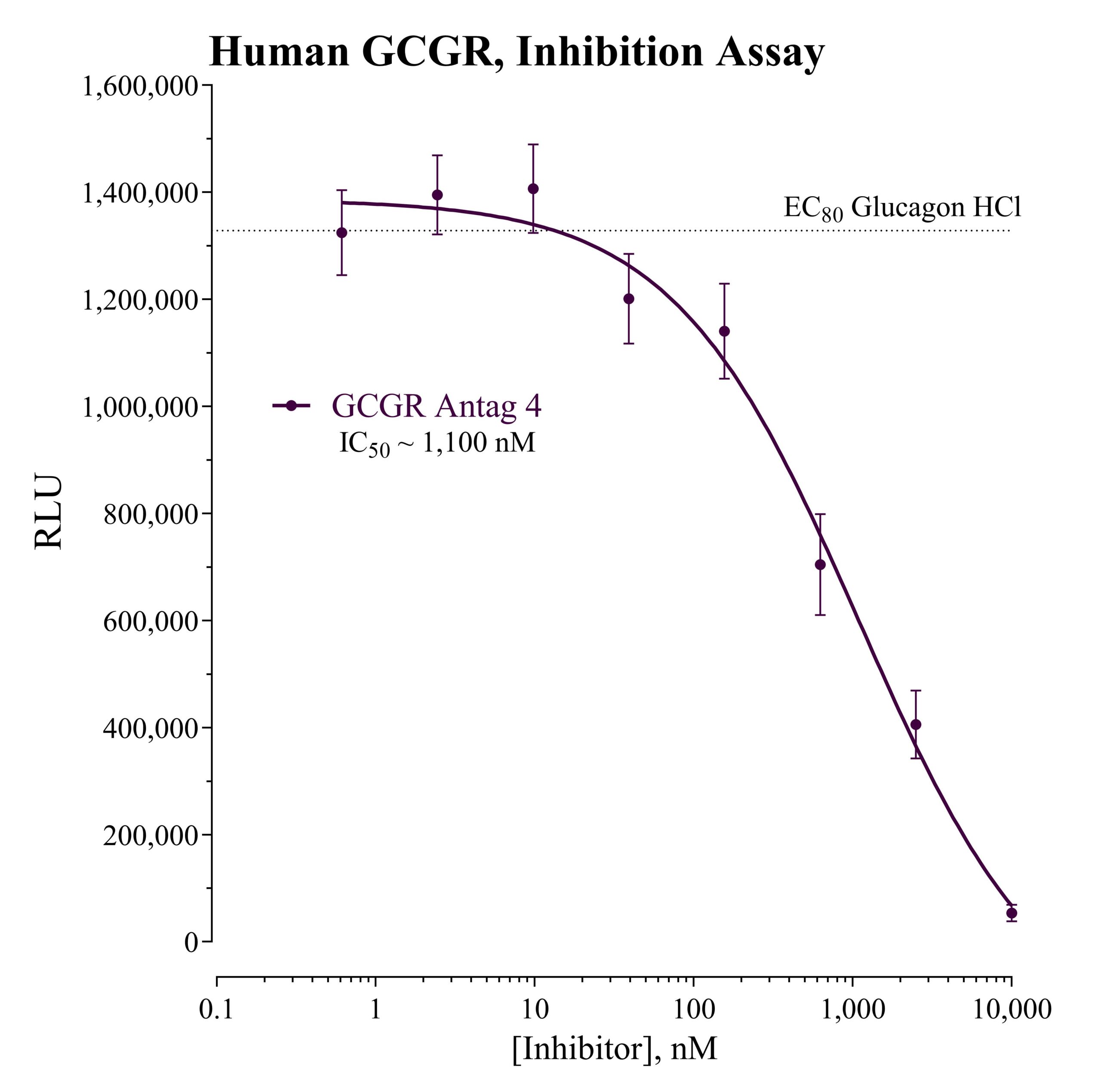
Target Background
Glucagon is a linear peptide containing 29 amino acids. It is secreted by islet α cells and mainly targets liver cells. Glucagon Receptor (GCGR) is a G-Protein-Coupled Receptor (GPCR) mainly detected in islet β cells and liver cells. After glucagon binds to GCGR, it promotes liver glycogen breakdown and increases blood glucose levels to stimulate insulin release. GCGR belongs to the class B GPCR superfamily and signals through Gαs/adenylyl cyclase activation, leading to an increase in concentration of the second messenger molecule cyclic adenosine monophosphate (cAMP).
The role of GCGR in the development of type 1 and type 2 diabetes (T1D, T2D) remains controversial, as conflicting evidence exists. However, each type of diabetes in animals and humans is associated with hypoglucagonemia.
Obesity is a chronic, treatable, neurometabolic disease that is projected to affect nearly a quarter of the world population by 2035. Novel therapeutics that engage with one or more of the GPCR targets, for example GCGR, GIPR and GLP-1R, have displayed positive results in regulating body-fat mass and energy homeostasis. Retatrutide, for example, is a single peptide conjugated to a fatty diacid moiety and has agonism toward GCGR, GIPR and GLP-1R. In recent phase 1b trials, treatment with Retatrutide led to a 10% weight reduction compared to a placebo control. GCGR, GIPR, and GLP-1R therefore continue to command considerable interest in therapeutic development and drug safety screening.

Citations
Also available as a service