Sub-Total: $0.00 USD


Have questions about this assay kit?
Human PGR Reporter Assay Kit
Product Description and Product Data
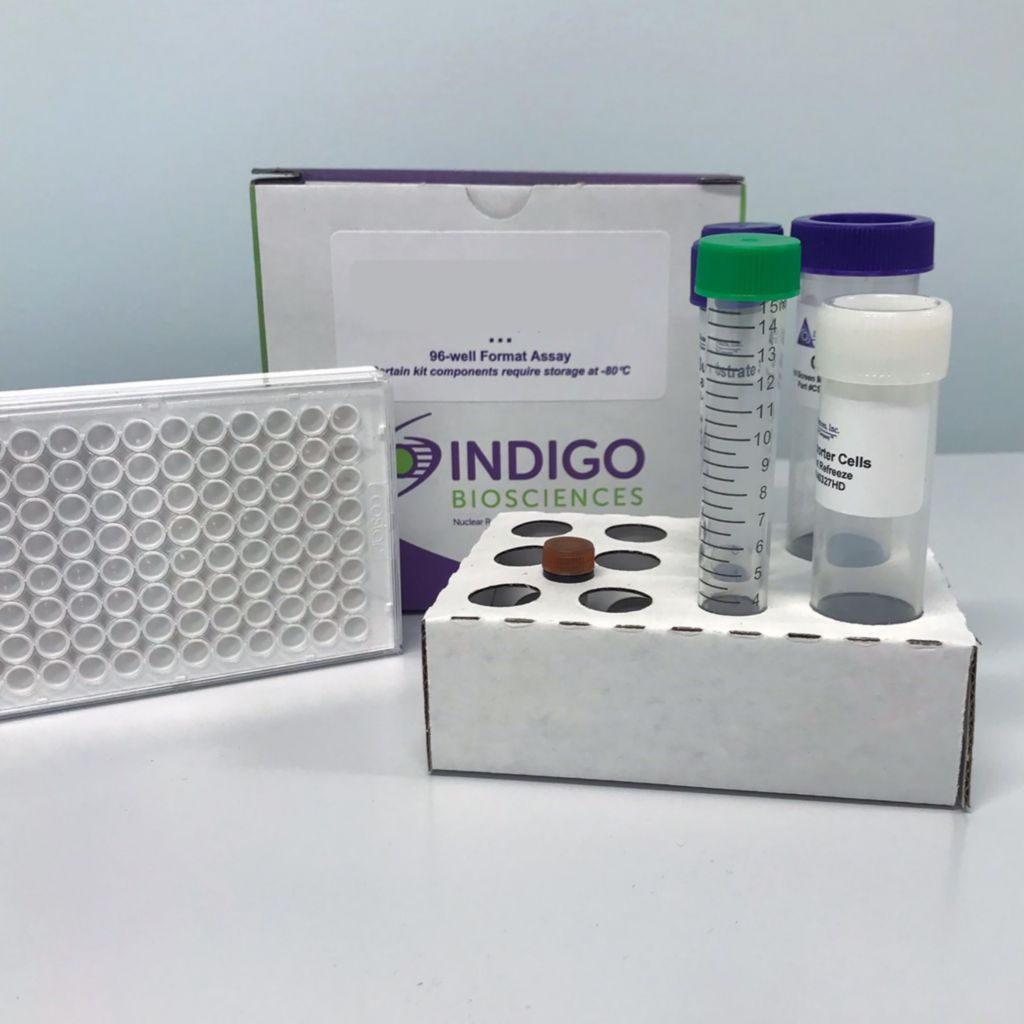
This is an all-inclusive cell-based luciferase reporter assay kit targeting the Human Progesterone Receptor (PGR). INDIGO’s PGR reporter assay utilizes proprietary mammalian cells that have been engineered to provide constitutive expression of the PGR. In addition to PGR Reporter Cells, this kit provides two optimized media for use during cell culture and in diluting the user’s test samples, a reference agonist, Luciferase Detection Reagent, and a cell culture-ready assay plate. The principal application of this assay is in the screening of test samples to quantify any functional activity, either agonist or antagonist, that they may exert against human PGR. This kit provides researchers with clear, reproducible results, exceptional cell viability post-thaw, and consistent results lot to lot. Kits must be stored at -80C. Do not store in liquid nitrogen. Note: reporter cells cannot be refrozen or maintained in extended culture.
Features
Ready to Use Upon Receipt
- Includes All Needed Components
- Contains Transfected Reporter Cells
- Eliminates Cell Licensing Fees
- Clear, Reproducible Results
- Consistent Results Lot to Lot
Product Specifications
| Target Type | Nuclear Hormone Receptor | ||
| Species | Human | ||
| Receptor Form | Native | ||
| Assay Mode | Agonist, Antagonist | ||
| Kit Components |
| ||
| Shelf Life | 6 months | ||
| Orthologs Available | Yes | ||
| Shipping Requirements | Dry Ice | ||
| Storage temperature | -80C |
Data

Target Background
INDIGO’s Human Progesterone Receptor (PGR) Reporter Assay System utilizes proprietary mammalian cells engineered to provide constitutive, high-level expression of human PGR (NR3C3), a ligand-dependent transcription factor.
INDIGO’s Reporter Cells include the luciferase reporter gene functionally linked to a PGR-responsive promoter. Thus, quantifying changes in luciferase expression in the treated reporter cells provides a sensitive surrogate measure of the changes in PGR activity. Luciferase gene expression occurs after ligand-bound PGR undergoes nuclear translocation, DNA binding, recruitment and assembly of the co-activators and accessory factors required to form a functional transcription complex, culminating in expression of the target gene. Unlike in vitro binding assays, and some other cell-based assay strategies, the readout from INDIGO’s reporter cells demands the same orchestration of all intracellular molecular interactions and events that can be expected to occur in vivo.

Citations
Priority screening of contaminants of emerging concern (CECs) in surface water: Comparing cell-based bioassays and exposure-activity ratios (EARs)
Vanden Heuvel, Granda, Ferguson et al
Sci Total Environ (2024) 953, 176115-176115 DOI: 10.1016/j.scitotenv.2024.176115
Vanden Heuvel, Granda, Ferguson et al
Sci Total Environ (2024) 953, 176115-176115 DOI: 10.1016/j.scitotenv.2024.176115
Cited by 7
Snippet: All cell-based reporter assay kits were from INDIGO Biosciences, Inc. (see Table 1)
NTS-105 decreased cell death and preserved long-term potentiation in an in vitro model of moderate traumatic brain injury
Dwyer, Amelinez-Robles, Polsfuss et al
Exp Neurol (2024) 371, 114608 DOI: 10.1016/j.expneurol.2023.114608
Dwyer, Amelinez-Robles, Polsfuss et al
Exp Neurol (2024) 371, 114608 DOI: 10.1016/j.expneurol.2023.114608
Cited by 7
Snippet: The functional efficacy and potency of NTS-105 at NHRs were evaluated using HEK293 reporter cells expressing recombinant human receptors functionally coupled through genetic response elements to a firefly luciferase reporter (Indigo Biosciences, State College, PA). Compounds (NTS-105 and canonical
Bioactive Rearrangement Products from Aqueous Photolysis of Pharmaceutical Steroids
Pflug, Knutson, Martinović‐Weigelt et al
Org Lett (2019) 21 (10), 3568-3571 DOI: 10.1021/acs.orglett.9b00972
Pflug, Knutson, Martinović‐Weigelt et al
Org Lett (2019) 21 (10), 3568-3571 DOI: 10.1021/acs.orglett.9b00972
Cited by 4
Snippet: and estrogen receptor (ER α and β) agonistic activity, but was less potent than 1 (Figure3). Costs limited evaluation of other analogues with this approach. Instead, further analyses of all analogues (1–4) were conducted with androgen receptor (AR), PR, and ERα reporter assays (Indigo Biosciences, State College, PA). (17)
Showing 1-3 of 5 papers.
Powered by BizGenius
Also available as a service