Sub-Total: $0.00 USD

Have questions about this assay kit?
Human CAR-1 Reporter Assay Kit
Product Description and Product Data
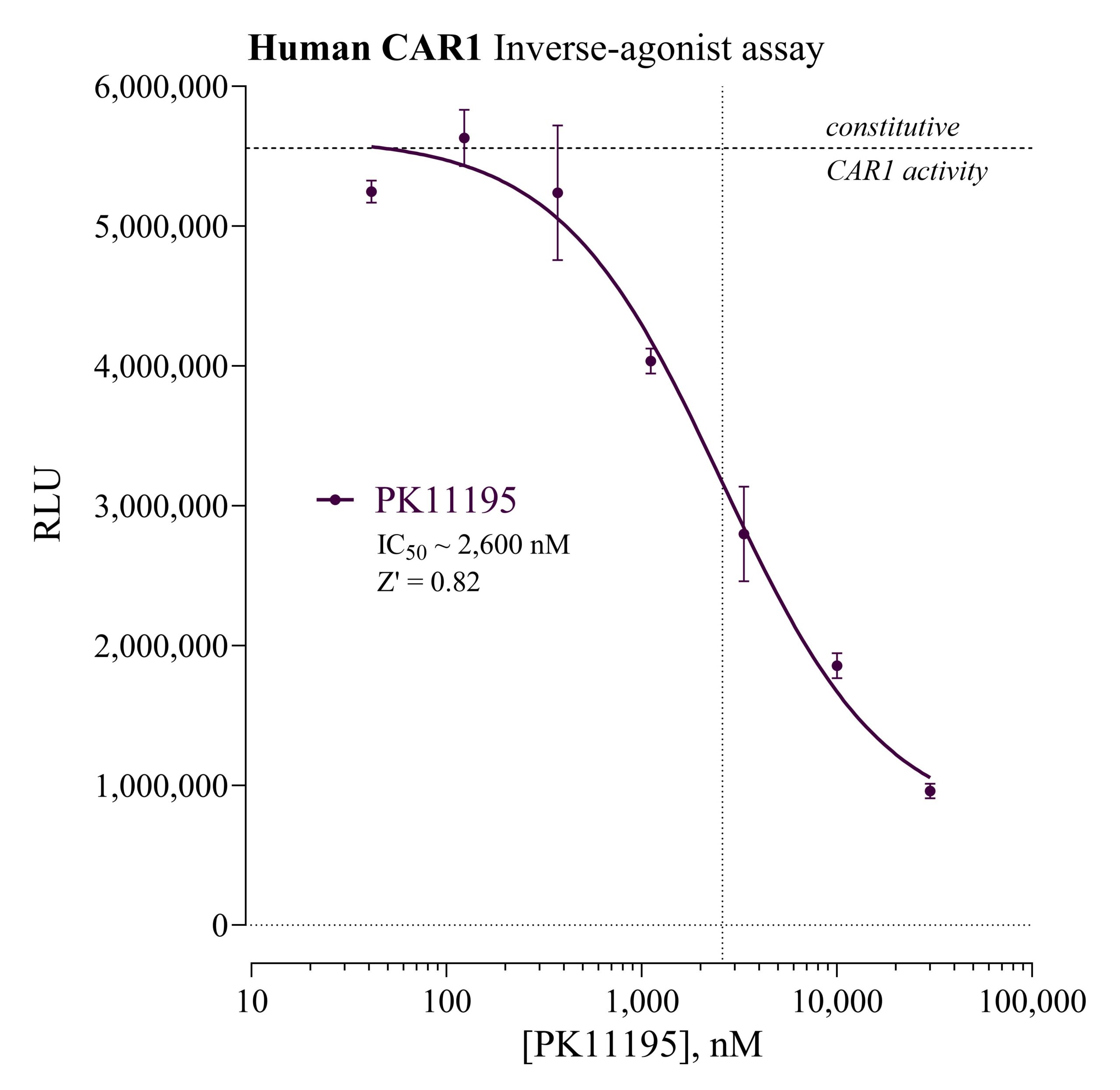
This is an all-inclusive cell-based luciferase reporter assay kit targeting the Human Constitutive Androstane Receptor-1 (CAR-1). INDIGO’s CAR-1 reporter assay utilizes proprietary mammalian cells that have been engineered to provide constitutive expression of the CAR-1. In addition to CAR-1 Reporter Cells, this kit provides two optimized media for use during cell culture and in diluting the user’s test samples, a reference agonist, Luciferase Detection Reagent, and a cell culture-ready assay plate. The principal application of this assay is in the screening of test samples to quantify any functional activity, either agonist or antagonist, that they may exert against human CAR-1. This kit provides researchers with clear, reproducible results, exceptional cell viability post-thaw, and consistent results lot to lot. Kits must be stored at -80C. Do not store in liquid nitrogen. Note: reporter cells cannot be refrozen or maintained in extended culture.
Features
Clear, Reproducible Results
- All-Inclusive Assay Systems
- Exceptional Cell Viability Post-Thaw
- Consistent Results Lot to Lot
Product Specifications
| Target Type | Nuclear Hormone Receptor | ||
| Species | Human | ||
| Receptor Form | Hybrid | ||
| Assay Mode | Agonist, Antagonist | ||
| Kit Components |
| ||
| Shelf Life | 6 months | ||
| Orthologs Available | No | ||
| Shipping Requirements | Dry Ice | ||
| Storage temperature | -80C |
Data
Target Background
The family of human Constitutive Androstane Receptors (CAR, NR1I3) regulate the expression of genes involved in xenobiotic metabolism and transport in the liver, including CYP2B and 3A4, UGT1 and MDR. Studies from mouse models show that CAR is also involved in bile acid, thyroid hormone and HDL homeostasis. The human CAR gene is subject to numerous alternative splicing events during pre-mRNA processing. The 348 amino acid isoform 1 of human CAR (CAR1) is encoded by 9 exons comprising the DNA binding domain (DBD), hinge region, and a ligand binding domain (LBD). The primary sequence of CAR2 differs from CAR1 in that it contains a four amino acid (VSPT) insert, whereas CAR3, which is the predominant isoform expressed in the liver, contains a distinct five amino acid (APYLT) insert.

Citations
Also available as a service